Stay Tuned: Indiana Announces Tax Amnesty Program Coming July 2026
indiana tax amnesty program

Indiana’s Upcoming Tax Amnesty Program at a Glance

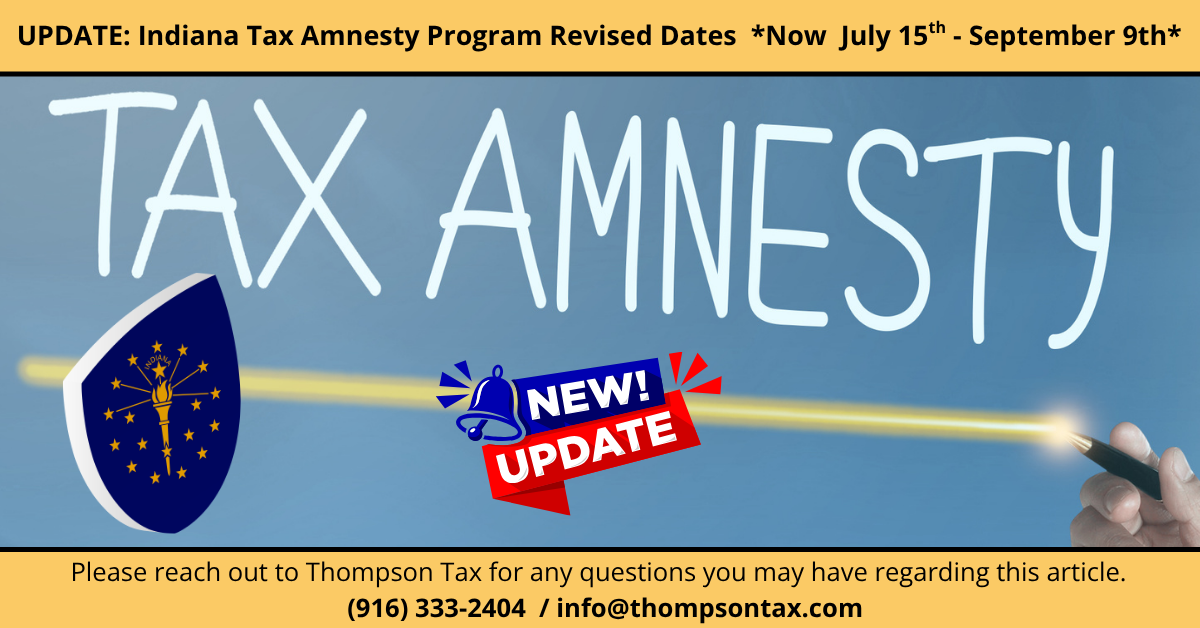
  • Indiana will offer a tax amnesty program from July 15 to September 15, 2026 for taxpayers with outstanding state tax liabilities.

  • The program covers eligible taxes due for periods ending before January 1, 2023.

  • Participants may receive waivers of interest, penalties, and collection fees.

  • Tax liens may be released and enforcement actions halted for compliant taxpayers.

  • Additional eligibility details are expected as legislation and guidance are finalized.

The Indiana Department of Revenue has announced that it is preparing to launch a tax amnesty program running July 15, 2026, through September 15, 2026. While key details are still forthcoming, the program is expected to provide meaningful relief for eligible taxpayers with outstanding liabilities.

Importantly, additional legislation (S.B. 243) is currently pending and will help finalize certain eligibility guidelines. The Department has indicated that further guidance will be released as the program date approaches.

Legislative Framework Behind the Program

Indiana’s upcoming amnesty initiative is required under legislation enacted in 2025 and effective July 1, 2025—H.B. 1001 (P.L. 213, Laws 2025).

Under this law, the Department must establish an amnesty program for taxpayers with unpaid tax liabilities for listed taxes that were due and payable for tax periods ending before January 1, 2023. “Listed taxes” generally include those the Department is authorized to collect or administer.

The legislation provides that:

  • Taxpayers may enter into a written payment program agreement for full payment of eligible liabilities.
  • The voluntary payment window may not exceed eight regular business weeks, ending before the date set by the Department or January 1, 2027, whichever is earlier.

Potential Benefits of Participation

For eligible taxpayers who pay all listed taxes due or comply with the terms of an approved payment agreement, the program must provide substantial relief, including:

  • Abatement of interest, penalties, collection fees, and costs otherwise applicable
  • Release of tax liens
  • No pursuit of civil or criminal prosecution related to the covered liabilities
  • Withdrawal (or non-issuance) of assessments, demand notices, or warrants for payment related to the listed taxes

As with prior tax amnesty programs, participation may offer a limited opportunity to resolve historical exposure with significantly reduced financial consequences.

What’s Next?

Pending legislation, S.B. 243, would both conform Indiana income tax provisions to certain federal changes enacted in the “One Big Beautiful Bill Act of 2025”, and amend aspects of the upcoming amnesty program. As of February 17, 2026, the bill was reported favorably out of the House Committee on Ways and Means and continues to move through the legislative process.

Because eligibility parameters and procedural requirements may evolve, taxpayers with potential exposure should begin reviewing:

  • Open tax periods ending before January 1, 2023
  • Outstanding assessments or unresolved audits
  • Existing payment plans
  • Lien filings or collection actions

We will continue to monitor developments and share updates as the Department releases formal guidance. Taxpayers considering participation should begin evaluating their exposure now to ensure they are prepared once the amnesty window opens.

Contact Thompson Tax today to begin preparing for this important amnesty opportunity. Our team can help you evaluate eligibility, quantify exposure, and navigate the process efficiently and confidently.


In response to recent wildfires in Los Angeles

firefighter holding spraying hose with fire in background

In response to recent wildfires in Los Angeles, Governor Newsom and the California Department of Tax and Fee Administration (CDTFA) have extended various tax filing deadlines and provided additional relief measures for affected businesses. 

Extended Filing Deadlines

  • Sales and Use Tax: The deadline for Los Angeles County taxpayers whose last return was under $1 million has been moved from January 31, 2025, to April 30, 2025.
  • State Income Tax: LA County taxpayers can postpone filing 2024 tax returns and making payments until October 15, 2025.

Additional Tax Relief

  • Interest and Penalties Waivers: CDTFA offers relief upon request for those not automatically covered by the extension.
  • Payment Plans: Flexible plans are available for impacted businesses.
  • Replacement Records: CDTFA will provide duplicates of lost or destroyed tax records free of charge.

Broader Assistance

  • Extensions and relief can be requested by taxpayers outside LA County who were also impacted by wildfires.
  • Some fees (e.g., annual cigarette and tobacco licensing) are not extended.

Stay Informed

On behalf of Thompson Tax, we extend our heartfelt sympathies to those impacted by the California wildfires. These communities have shown incredible courage in the face of uncertainty and loss. To aid in their recovery, we have donated to the American Red Cross and encourage you—if you are able—to contribute there as well or to another organization of your choice.

As The Holiday Season Approaches, Thompson Tax Is Proud to Support Those in Need

Assortment of Donations for Local Food Bank

Thompson Tax is proud to support local charities that make a meaningful difference in our community, and as the holidays approach, we invite you to join us in these efforts. By working together, we can have a greater impact on the lives of those in need, strengthening the bonds within our community and fostering a spirit of giving. Whether through donations, volunteering, or spreading awareness, every contribution helps. We encourage you to get involved and be part of something bigger. Together, we can make a lasting difference!

Sacramento Food Bank & Family Services 

Food Depository in Chicago | Greater Chicago Food Depository (chicagosfoodbank.org)


Franchise Tax Refund Opportunity for Tennessee Business Owners!

Franchise Tax Refund Opportunity for Tennessee Business Owners

Recently, Tennessee passed a new law repealing its franchise tax for in-state businesses. The franchise tax was levied against companies for the privilege of doing business in the state and was based on the higher amount of either a business’s net worth or the value of its property in Tennessee.

This repeal brings significant financial relief to Tennessee business owners. What’s even more exciting is that the repeal includes refunds for periods dating back to 2020. Tennessee has allocated a substantial amount (over $1 billion) to refund businesses that paid the franchise tax during the 2020 through 2023 tax periods.

Act now to seize the largest refund opportunity in Tennessee’s history! With one less tax to worry about, this is the perfect time for business owners to explore new avenues for business growth.

Curious if you’re eligible for the refund? Don’t delay! The refund window is only open from May 15, 2024, through November 30th, 2024. Reach out to Thompson Tax today to check your eligibility. It’s time to put your money back where it belongs – with your business!

The Ins and Outs of San Francisco’s Gross Receipts Taxes

Tax Professional Carrying Tax Binders with Gross Receipts

San Francisco’s gross receipts tax regime is a complex system comprising three unique taxes that are layered together. It is imposed on mostly any person engaging in business within San Francisco, aside from those qualifying for a small business exemption.

If you are a business owner in San Francisco, understanding the gross receipts tax regime and tax rate is crucial to ensuring you file your tax returns correctly. Accurately determining your NAICS code will help ensure you pay the correct gross receipts tax rate. Misclassification can result in underpaying or overpaying taxes, leading to penalties and interest charges. By working with a tax professional and keeping accurate records, business owners can ensure that they will prevent any potential financial consequences.

Contact Thompson Tax today to discuss your business needs; savings opportunities surrounding gross receipts taxes are available, and we are here to help!

Taxpayer Wins in Massachusetts “Cookie Nexus” Case

Concept of Cookie and Gavel with a Map of Massachusetts in the Background

The Supreme Judicial Court of Massachusetts has ruled in favor of the taxpayer in the Auto Parts Network Inc. v. Commissioner case. This ruling denies the Massachusetts Commissioner of Revenue to consider the use of cookies, apps, and content delivery networks (CDNs) while deciding whether a vendor has physical nexus with the State of Massachusetts.

The Commissioner of Revenue argued that cookies, downloadable apps, and CDNs created the physical presence in Massachusetts necessary to enforce taxation laws under the Quill v. North Dakota standard.  By using this standard, the audit division of the Department of Revenue sought to require US Auto Parts to register for, collect, and remit sales tax in Massachusetts.  As additional evidence of the commissioner’s claim, they argued that the standard established by Wayfair v. South Dakota could be applied retroactively to require enforcement of 830 Mass Regs § 64H.1.7 when applied to out-of-state vendors.

After deferring to the Appellate Tax Board and then the U.S. Supreme Court, the Massachusetts High Court ruled in favor of the taxpayer.

Please let us know if you have any questions about this case or how it may affect your business.